Tag: book-review

  • The Kikiloa Chronicles

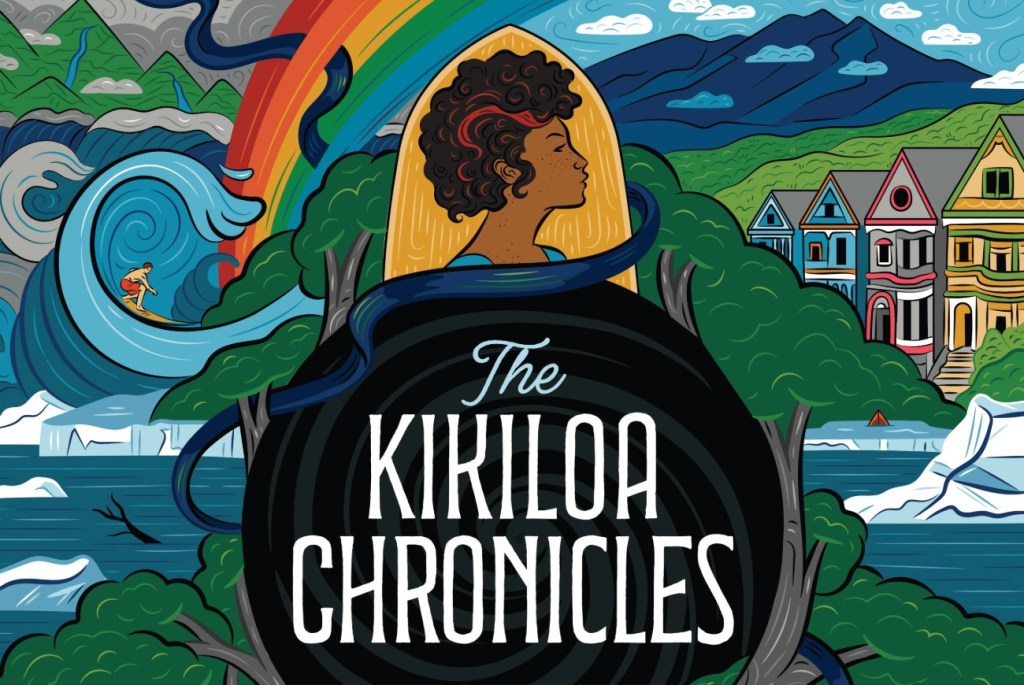
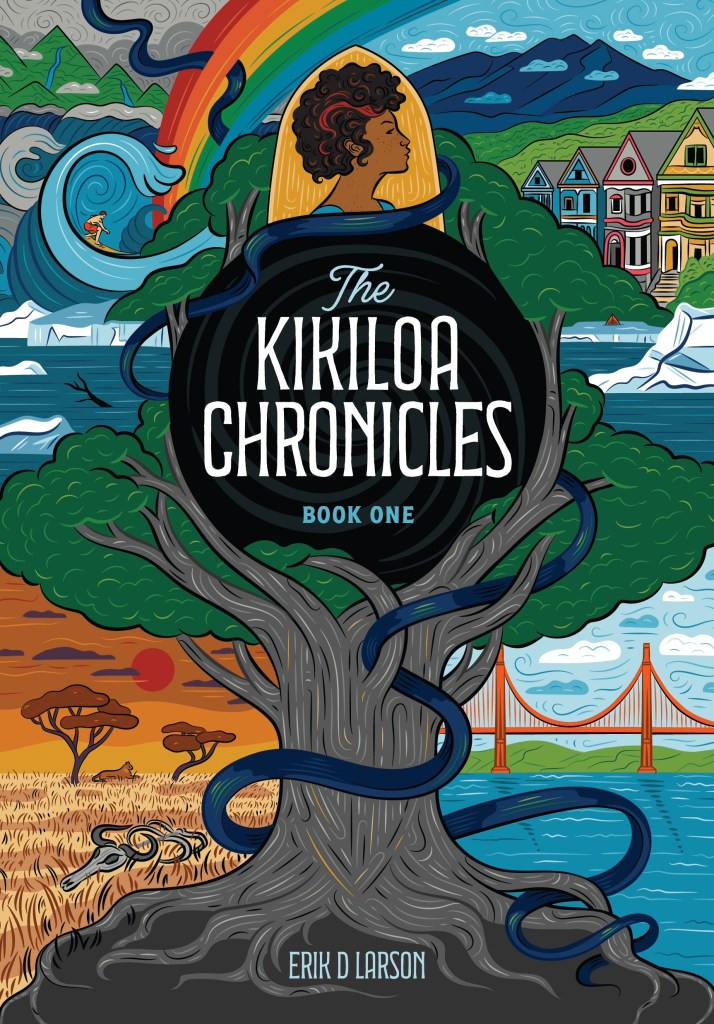
    The Kikiloa Chronicles

    A Literary Science Fiction Novel of Time Travel, Magical Realism and an Irrepressible Mitochondrial Eve

    By Erik Larson

    Coming July 2026!

    Subscribe for news at: https://kikiloachronicles.substack.com/


    Kikiloa is Mitochondrial Eve, the 200,000-year-old mother of humanity and our lyrical first storyteller.

    As a time surfer flickering across a trillion universes, she’s determined to discover an antidote to entropy before everything meaningful is lost.

    And now she’s a freckled fourteen-year-old trickster bounding across a San Francisco park to meet her kind, grounded friend Hazel, who Kiki believes can cause even death to pass people by. Probably.

    When a cliff collapses beneath them and Kiki vanishes mid-fall, Hazel is left alone with their attacker to begin her contemporary coming-of-age, while Kiki’s hopes unravel back to the trauma of her bleak beginnings as outcast and slave in a dystopian prehistoric world.

    But Kiki never lets up, whether lamenting a Hawaiian tsunami, alchemizing sniper attacks, telling quantum stories, weaving through highway pileups, going Jungian, or baking perfectly average cookies. And throughout, she spars with her infuriating, enigmatic mentor Paha, who believes surfing is elegy: all waves break, and fighting the end only creates suffering.

    The Kikiloa Chronicles is Erik Larson’s emotionally vast, funny, and wild speculative literary debut, carried by Kiki’s unmistakable voice from the devastating loneliness of her first life to the hard wisdom of friendship. Irrepressible and imperfect, she wrestles with love, a force like gravity, alive at the core of a universe destined for darkness.

    David Mitchell meets A Wrinkle in Time by way of Matt Haig and Ursula K. Le Guin.

    Content Note

    This story contains scenes of natural disasters with loss of life, gun violence with young teens in danger, and sexual oppression in a dystopian prehistoric setting. The scenes are not graphic, but readers sensitive to these themes may wish to know in advance.

    Advance Praise

    “I don’t think I’ve ever read anything quite like this, not in scope or execution. It’s emotionally rich, and that’s in large part because the characters feel like distinct, real people.” — Ruchi, early reader

    “I was immediately gripped and fully immersed from the first couple of pages. The twists and turns kept the story moving, and vivid imagery carried me through the key dramatic moments — the tsunamis, the iceberg ride, the dream of the many-trunked tree. I didn’t want to put this book down.” — Jess, early reader

    “There was never a place where I didn’t want to keep reading. In a way, it was like riding a wave. All I had to do was ride and let the water take me. I didn’t want it to end.” — Leo, early reader

    “Kikiloa is painfully human — messy and emotional and reactive. She makes mistakes and holds grudges. But mostly, she loves fiercely. You don’t expect to connect with a 200,000-year-old being who has seen and experienced so much, but this story does that for you at every turn.” — Kaycee, early reader

    “Science in fiction in the spirit of Madeleine L’Engle — folding in both the fantastical and the philosophical. Defies genres beautifully.” — Caroline, early reader

    The Kikiloa Chronicles: A Literary Science Fiction Novel of Time Travel, Magical Realism and an Irrepressible Mitochondrial Eve
  • Sample of The Kikiloa Chronicles: Book One


    At The End Of Time


    Prelude: I am Kikiloa


    I was enslaved after the fire.

    I birthed only daughters, more than I could track on my fingers and toes. I remembered them by the dark freckles scattered across the backs of my hands. I’ve since learned to count and know the living were twenty-one daughters by twenty different men.

    None of my daughters resembled me until my twenty-first and last. She was the child of a forbidden lover, a man my father killed too late to preserve our tribe’s harmony. She was stillborn in my forty-second year, a speckled blue baby strangled by her umbilical cord. The weight of her lifeless body broke the scales of my grief and freed me.

    With age, my freckles multiplied, darkening my skin in a mottled tapestry. Despite time’s weathering, I can still find each daughter in those scattered marks, an alphabet of memory.

    I am Kikiloa.

    I am Mother, the harbinger of humanity, ancient yet not atavistic. I forespoke your future, and you echo my past. We share our genes. We share our deepest dreams.

    But my life has since multiplied beyond reckoning.

    I’m connected across more of my selves and a longer span of time than the sum of all our lives. With a flicker, I can find you in any moment. And perhaps I found the girl who can save everything.

    But I’m getting ahead of myself, as tricksters do.

    Let me tell you what I’ve seen, and some that I’ve surmised.

    I’ll start two years before my first taste of toast and chocolate.


    Present Day


    Chapter One: I’ll be quick

    Hazel sat alone on the swing set, looking out from the park as the midday sun burned back the wall of fog looming over San Francisco. The cold Pacific breeze curled over the cliff behind her, winding through swaying pillars of cypress and pine to tease at her honeyed hair.

    She imagined herself sketched beneath the misty curtain like a conductor before her orchestra. For a moment, she felt the gaze of thousands of people watching the fog’s daily spectacle from windows scattered across the city below, wondering if any could see her. Then she remembered the time and pulled her phone from her backpack.

    kiki, ru coming? she texted.

    Hazel had grown familiar with my loose attitude toward time. I was late today, but I was just as often early. I’d once showed up at ten in the morning for a movie that didn’t start until six that night. As far as she and everyone else knew, I was a homeschooled free spirit with a bike, a bus pass, mysterious Kenyan parents who were always traveling for business, and a cranky nanny who never answered the phone and never said no. If you’re cute and confident enough, people will believe anything.

    While Hazel gave me leeway, she’d been raised believing that being on time showed respect for others, and she made a habit of sending me helpful reminders. I didn’t mind the prompts, but I still showed up when it suited me.

    “Hey!” I shouted as I emerged from the steep path leading down from the dog park. I bounced across the grass, twirling with outstretched arms, my adolescent body buzzing with energy. I am ancient. Still, in a young body, it’s easy to forget.

    Hazel often doodled me as a living spark, my antics jolting with electricity, my tightly crimped cocoa-and-red curls arcing in all directions. I talked in flowing bursts and grinned freely, my pale green eyes shifting with the light, my earrings seeming to glow against my dark-speckled skin like the bioluminescence Hazel remembered from a fateful trip years ago.

    “Sorry I’m late. I didn’t want to be an uptight wacko,” I deadpanned.

    “No one would call you uptight,” Hazel replied, her blue eyes glinting above cheeks still rounded with adolescence.

    “Yeah,” I laughed, my body still fizzing even at rest. “Your parents aren’t home, right? Want to climb up to the Penthouse?” I pointed at the cliff bordering the park.

    She looked down at her carefully selected school outfit, then slipped off her light pink jacket and stuffed it into her backpack. “Sure. My brother has a lacrosse game. They won’t be back for a while.”

    “Then let’s go!” I cheered, bounding away toward the dusty scree. Hazel looked down at her carefully mended jeans, shrugged, and followed.

    We scrambled up the dark gray rock, angling toward a ledge cut into the cliff forty feet above.

    ~~~

    The ledge was hidden from the park below. Hazel hadn’t known it existed until breakfast the day after her twelfth birthday, when her dad pointed out a small orange tent that had bloomed on the cliff overnight. A man stood outside it, nonchalantly brushing his teeth.

    “Wow, that guy picked a million-dollar penthouse view,” her dad said. And so, the ledge became the Penthouse.

    The man was a topic of family conversations for several days until her mom finally called the police when he relieved himself over the ledge in full view of the park.

    It took hours for the police and firefighters to get the man down. No one was willing to climb up after him, so they watched as he calmly packed up his belongings and then scaled down the cliff as if he’d done it a thousand times. His burnt-orange windbreaker caught Hazel’s eye. His face was deeply tanned and clean-shaven. He gave her a lion-yellow wink as the cops escorted him from the park.

    “Don’t you two climb up there,” Hazel’s mom had warned at dinner that night. “Who knows what he left behind? Needles and, you know… stuff.”

    Intrigued, Hazel’s brother, Lee, looked out the dining room window and up at the cliff.

    “And poop,” her dad added, noticing Lee’s interest. “He was up there for days. That’s the ‘stuff’ your mom means.”

    Lee’s nose wrinkled in disgust.

    Hazel doubted her dad’s story. The man was the most clean-cut urban camper she’d ever seen. The day before, she’d secretly set out a thermos of leftover soup near the path to his ledge. That morning, she’d found the empty container on their front steps, carefully washed and wrapped in orange craft paper. That didn’t seem like something someone who left “stuff” everywhere would do.

    A few days later, Hazel met me for the first time. She spotted me climbing down the rocks below the ledge. Curious, she called out.

    “Hi! Were you up on that ledge? Is there, uh, poop up there?”

    “Nope!” I said with a bright smile. “Just a great view, and some sitting stones where the Ohlone wise ones talked story back in the day. I’m Kiki!” I ended with an enthusiastic click of my tongue.

    She smiled back, quizzical and suddenly a little shy. “I’m Hazel.”


    ~~~

    Hazel clambered over the exposed roots of a large cypress that clung to the cliff ledge, hauling herself up onto the ledge and joining me at a semicircle of sun-warmed sitting stones. Sheltered from the chill breeze by cliff and trees, we shared a bag of roasted seaweed from Hazel’s backpack and played our version of “I Spy.”

    The bay gleamed in the bright sun, the tops of the Golden Gate Bridge soaring above a tongue of fog jetting in from the ocean, the dark slopes of Mount Tam rising beyond. Alcatraz hid in the fog, the deep surrounding waters flecked with whitecaps. Directly below, the city marked out intersecting diagonals of pastel neighborhoods backed by mirrored skyscrapers. Cargo ships dotted the bay, disappearing into Silicon Valley’s bright haze.

    “I spy a sunburned bald head,” I said, looking east.

    Hazel scanned the park below, but it was unusually empty for this time of day. I held my gaze steady until she spied Bernal Peak’s rust-red hump poking up through the street grid.

    “I spy silver rainbows,” Hazel said, leaning back until the city hung upside down behind her.

    I quickly spied the shining spans of the Bay Bridge.

    I loved our games, but I was stalling. I’d been stalling ever since we met two years ago, enjoying the childhood friend I’d never had. But now it was time.

    I turned to her, mock-serious. “I spy someone I need to talk to.” I tapped Hazel’s backpack with my toe. “Got any water in there?”

    Hazel raised an eyebrow in response and pulled out her water bottle.

    “I’ll be quick.” I unscrewed the cap, took a sip, and said with a straight face, “Let’s start with this, I’m not here.”

    Hazel waited expectantly, taking back the water, patient with my conversational oddities as always.

    Suddenly, a sharp crack sounded deep in the rock ledge beneath us. The colossal cypress shuddered as its roots ripped free from the cliff face, its cantilevered weight dragging a car-sized section of the ledge loose. A fracture ratcheted toward us across the rock shelf, discharging sharp flakes and puffs of dust.

    I leapt up and yanked Hazel away from the growing fissure, rolling her over me in a fluid somersault that ended with her sliding to a stop on the solid rock beyond the sitting stones.

    “Whoa. That’s a big one!” I called out, my eyes unfocusing as I registered a familiar surge emanating from every detail of the scene.

    I sprang to the edge near the doomed tree, knees bent and arms out in a surf stance as the ledge tilted further beneath my feet. I flickered in and out. “It won’t break,” I breathed, then looked uphill and raised an angry fist.

    Startled, Hazel followed my gaze and saw a splash of orange — the jacket of a man, vaguely familiar, standing in the dark trees above the cliff with a pickaxe on his shoulder. Did he do this?

    Paha gave us a perfunctory wave before turning into the shadows with a glint of his sunglasses.

    The tree groaned, tilting further until its trunk stuck straight out from the cliff. Wood and rock popped and squealed under the strain. Several large stones broke free from above the ledge and crashed past us, sparking a hot, sulfurous smell.

    “Asshole,” I muttered to myself, shuffling to keep my balance. “What’s he playing at? Maybe another ‘accident’…”

    I turned to Hazel. “You gotta get out of here.” I flickered again. “Don’t worry, you’ll survive.” I flickered once more, like a flip book, testing. “Probably.”

    “Kiki, what is going on?! Come back from there!” Hazel bellied forward, swinging her backpack toward me like a lifeline. “Grab this!”

    I flashed a final smile, sidestepping the moment’s pressing weight. “Really, don’t worry. I’ll find you later and explain everything. Just go. Go home. Oh, and maybe lock the door.”

    I crouched and flickered one last time. “Yeah. This’ll do.”

    The ledge gave way beneath my feet. I spun, extended my thumbs and pinkies to throw Hazel a double shaka, then fell backward off the cliff, vanishing with a soft snap, as if the air had swallowed me whole.

    The empty park echoed with the crash of the falling tree.


    Chapter Two: Kiki, what the hell?

    Stunned, Hazel inched across the sundered rock shelf and peered over the edge, stomach sinking, searching for me.

    The rock slab had dropped from beneath me and lodged at the base of the slope, still grasped in the fallen tree’s roots. The tree lay upended, its broken branches spearing into the blackberry brambles bordering the playground lawn. A final cascade of pebbles spilled from the cleft. Dust drifted outward, twisting into the wind. There was no sign of me.

    Hazel eased back from the edge, closed her eyes and took a deep breath, then scanned the park. One of the stone seats from the shattered semicircle had landed near the swing set, the square boulder embedded in the grass. A few broken branches were scattered nearby. The park lay quiet, and a glance at the street revealed it was deserted too. Spooky. She shook her head. The empty playground was a miracle at this time of day. At least no one else was hurt.

    Hazel reached into her backpack and found her phone smashed and unusable. Jittery and unsure what she’d seen, she scrambled off the broken ledge, picking her way down the loose scree, pressing on despite gruesome visions of me flattened like the Wicked Witch of the East beneath Dorothy’s house. She searched the wreckage, finding nothing, then pushed through the blackberry brambles, snagging on thorns again and again until she accepted that, incredibly, I’d vanished into thin air.

    She slumped to the grass and wrapped her arms around herself. “Kiki, what the hell?” she whispered.

    Then she remembered the threatening man atop the cliff. A chill crawled across her scalp.

    She jumped up and sprinted across the street to her house, slamming the deadbolt and wedging the foyer bench against the door. She started to check the window locks but froze. What good were window locks against a man with a pickaxe? She considered running to a neighbor’s house but couldn’t shake the feeling he was watching, waiting for her to do just that.

    She backed away from the door, wanting to hide, but their small Marina-style house sat on the corner across from the park. Anyone could see straight into every room. She bumped against the plain cherry dining table and spun around in fright. The spindle-backed chairs and arched flower arrangement were etched in sharp relief by the afternoon sun. The room felt starkly exposed. Family dinners had always felt cozy and safe, but now the windows gaped wide, unsparing.

    Heart pounding, she ran to the kitchen computer and pulled up the family chat.

    Hazel: mom, dad, call 911! there was a man in the park he had a pig ace

    Hazel: *pickaxe

    Hazel: my phone is smashed, pls call them

    Mom: What? Is this Kiki? This is not funny.

    The video call opened, and Hazel’s mom looked out from the screen. She was in the car, and Lee was visible in the back seat, twirling his finger at his temple.

    “Hazel, what are you talking about? Is Kiki there?” her mom demanded, suspicious of my pranks. Half-wary and half-indulgent, her parents treated me like a mischievous stray, humoring my quirks and privately blaming the worst on my own perpetually absent parents.

    “No, Mom, it’s, uh, just me,” Hazel said, then paused, wondering how to explain what had happened and still be believed. She was reluctant to tell her mom everything. Looking back, I see how my vanishing act pulled her further away from her mother, perhaps too soon. But it is always too soon.

    “I was waiting for Kiki in the park…” She paused, then cut me out of the story entirely. “A tree and part of the Penthouse ledge fell down and almost hit the swing set. There was a man up there, and he had a pickaxe.” She swallowed, struggling for a story as close to the truth as possible without mentioning my impossible vanishing act. “I was afraid he’d come after me. I locked myself in the house. I don’t see him, but I’m scared he’s still out there.”

    The car whooshed in the background as her dad careened through the streets. He told Hazel to hide in their bedroom closet. Her mom called the police, and Hazel gave a brief description of the man, emphasizing the sunglasses, the orange jacket and the pickaxe.

    “Maybe we should have her get the gun,” her father said.

    “Wait, what?” Lee exclaimed. “What gun?”

    “Dad!” Hazel scolded. “You guys have a gun? Don’t you know that guns kill way more family members than criminals?”

    “Guns don’t kill people,” Lee deadpanned. “People do.”

    Her mother cut in. “Honey, forget the gun. Lee, not funny. Hazel, stay calm. Get in the closet. Now. The police are on their way.”

    Hazel heard sirens in the distance. They’d always disturbed her, howling her awake, haunting her walks, pressing into her studies and raising the hairs on the back of her neck as the vehicles charged forward, carrying police officers, firefighters, and paramedics to their tragic destinations. Now she urged them on.

    When her family arrived, four officers were questioning an older man in sunglasses and an orange jacket. The man stood leaning against the park fence, gesturing calmly at the cliff and Hazel’s house as he explained himself. Hazel slipped outside and stood behind her father on their front steps, white-knuckled fingers clutching the back of his shirt. Paha was unfazed by the interrogation, of course. At last, he walked off with a stout walking stick in hand, and two police officers peeled away to speak with Hazel’s father.

    “Well, sir, that guy was hiking above the park and heard the rockfall. He saw the girl and headed down to check if she was okay. He didn’t have an axe,” the officer said with a slight smile. “Just his walking stick. His ID checks out. With the landslide and everything, it must have been a scary situation for your daughter.”

    The officer nodded reassuringly at Hazel over her father’s shoulder. “It’s good that you called, young lady. It’s better to be safe than sorry.” He waved toward the park, where the other officers were stretching caution tape around the fallen tree. “You’re lucky you weren’t hurt. That big stone near the swings is in there pretty deep.”

    Sometimes luck is more than it seems.


    Chapter Three: Sneezing into a bowl of glitter

    Hazel had been quiet at dinner, feigning embarrassment about her report of the man with the axe and unsettled by the surreality of what had happened and her own willingness to hide the truth. Now, propped up on her pillows and bathed in the warm glow of her bedside lamp, she wrote steadily, her words unspooling across the pages of her journal.

    Her bedroom was tucked into a corner of the garage below her parents’ room. On foggy nights, it was dark and a little cold. She’d swapped rooms with her fraternal twin Lee several years ago after he complained about the dark and made it her own by collaging the wall with maps and pictures cut from travel magazines. When it rained, she opened her garden window to breathe in petrichor, the living breath of wet rock, her favorite scent.

    She hovered over the final word, then set her pen down with a sigh and shook out her cramped fingers. She’d recounted the day as best she could, recording what I’d said and done, matter-of-factly documenting that I’d been about to reveal something important and suddenly vanished. My disappearance felt oddly familiar, just a more extreme “that’s Kiki” moment. Somehow, she knew I would return.

    Hazel flipped back through her journal, hunting for past zingers. My best quotes inspired doodles, making them easy to spot. There was an inscrutable gem about my favorite chocolate chip cookie recipe: “I spent a wide time to get these cookies right. They’re almost perfectly average!” Beneath it, a cookie-shaped doodle of my Cheshire Cat grin stretched extra wide. My quote about our mistimed movie playdate was illuminated by a looming watch face sticking out its tongue. Many more doodles culminated with my quotes from the cliff ledge: “I’m not here,” and “Don’t worry, you’ll survive. Probably.” There were no doodles for those, at least not yet. She’d started a sketch of the man with the pickaxe but left it unfinished.

    She yawned, setting her journal aside and lying back on her bed. She briefly thought of the fundraiser she was doing with her surfer friend Sam and beanpole buddy Peter. It had been her main preoccupation for weeks. But now her mind kept returning to me.

    Hazel talked freely when we were together. I was a fun, nearly perfect audience, the playful patience of a grandmother wrapped in the vibrant body of a teenage girl. I was genuinely interested in what she had to say and appreciated the wisdom in her simple advice, even when I didn’t follow it. And I kept my interruptions to a barely disruptive minimum, mostly. As a result, Hazel didn’t steer the conversation away from herself as she did with other people. She let her train of thought run free.

    She recalled a conversation we’d had a few weeks earlier on a walk down to the neighborhood’s main street for bagels.

    “I love that house,” Hazel said, pointing at a dark gray Victorian with pink trim and gilt flower garlands bracketing the bay windows.

    “Yeah,” I said, drifting a few steps behind, my quick flickering unnoticed. “It’s one of the best versions,” I confirmed. “What do you like about it?”

    “That round attic window. I imagine the sun shining on dust motes and a warm, creaky floor.”

    I nodded with an appreciative smile. “What do they do up there?”

    “Mostly art and scientific experiments,” Hazel said, sliding further into fantasy. “The girl is eclectic. Her desk is right by the window, so she can look down past her notebook at the tops of our heads while she writes. It’s her favorite spot. People walking by spark her imagination.”

    “That’s what she thinks until she knows better,” I added. “Eventually, she learns she’s got it backward. Our imagination makes people sparkle.”

    Those twists and turns were her favorite part of our conversations. I did it with everyone, but most people, especially adults, politely ignored me, pointing out what they saw as mistakes or exaggerations or otherwise suggesting I be more sensible. Hazel was different, naturally embracing a “yes, and” philosophy.

    “Do you think it will hit her all at once?” Hazel asked. “A real eureka moment?”

    “Yeah, like sneezing into a bowl of glitter. It’ll happen all at once, then take years to clean up.” I stopped short, distracted. “Oh my gosh, look at that cute dog over there!”

    I darted across the street to a young retriever considering a fire hydrant. I asked the owner if I could say hi, then planted a kiss on the dog’s wet nose and got a happy lick in return.

    Laughing, I skipped back across the street, wiping away the slobber.

    “That’s so gross, Kiki.”

    “The dog thought the same thing,” I replied. “He loved it.”

    Reaching for her journal with another yawn, Hazel smiled at the memory. She began doodling the dog sneezing into a bowl of glitter, the two of us dancing in the sparkling shower. Her pen trailed off the page as she slipped into sleep.

    ~~~


    Hazel jolted awake in the dark, her T-shirt damp with sweat, her mouth dry. She’d fallen asleep fully dressed. She peeled back the covers and padded upstairs to get water from the kitchen.

    The blue glow of a computer shone beneath her brother’s door, accompanied by his murmured video game chatter. The microwave clock read 11:11. She could hear my wisecrack in her head: “It’s an arbitrary time, make a wish!”

    Water in hand, Hazel stepped to the window and looked across the street. The full moon bathed the park in pale light, revealing the heavy line of the newly fallen tree.

    She poked her head into Lee’s room, then slipped inside and sat on his bed. He pulled his gaming headset off one ear in acknowledgement.

    “Any axe murderers out there?” he teased.

    “Looking for an excuse to give that gun a try?”

    Lee turned from his computer, setting the headset aside. “Yeah, can you believe it? I think it’s a nine millimeter. I was joking with Dad about his Glock, and he didn’t deny it.”

    She mimed firing it sideways, gangster-style. “Hey, I need your help. I want to go up to the Penthouse to look around.”

    “Back to the scene of the crime? Classic move. It’s best at night. Gives the bad guy more chances to sneak up on you.”

    “Yeah,” Hazel said with a shiver, then steeled herself. “But tomorrow they’ll be strict about keeping kids away from the cliff. I want to see if that guy really did try to make it fall on us.” She gave Lee her best puppy-dog look. “And I need backup from my big brudda in case he’s still sneaking around.”

    Technically, she was five minutes younger, as he regularly reminded her.

    He rolled his eyes and reached for his hoodie. “Fall on ‘us,’ huh? So you had company at the scene of the crime. Sure, I’d love to help you and Kiki with your axe murderer. No need to tell Mom and Dad, or Kiki’s parents, either. Does she really have parents? Anyway, it’s a great idea. I’m sure they’ll all be fine with it. Let’s go.”

    They crept downstairs and found two headlamps amid the camping gear. Lee also grabbed a narrow spade from the gardening tools. As they slipped under the garage door, the metal blade scraped harshly against the sidewalk. They listened carefully, but their parents didn’t stir. Hazel shook her head.

    “Hey, in the right hands, a shovel is as deadly as an axe, and much better for burying the body afterward,” he whispered.

    They scrambled up the dusty scree beside the fallen tree to the bright moonlight of the ledge. Lee stayed vigilant at first but soon switched off his headlamp and leaned lazily on his spade, texting and scrolling while Hazel climbed over the tree’s upended root ball. Her meticulous inspection uncovered several severed roots, the stark white wood showing clean chop marks. She spotted matching root stubs protruding from the scarred cliff face.

    “Lee, look at this!”

    He started toward her, then stopped mid-step. “Shhhhh!” he hissed.

    “Why? No one can hear us up here,” Hazel whispered back.

    Limned by moonlight, Lee turned toward the far end of the ledge, shovel gripped like a spear. When my shadowy figure landed on the stone ten feet away, he sprang forward with a surprisingly deep roar. I turned on my phone’s flashlight, catching the shovel blade as it sliced toward my grinning face.

    Recognizing me, Lee flung the spade aside and threw his arms wide, tackling me full force in a clumsy collision that drove us both to the ground.

    Hazel approached through the haze of our impact, her headlamp illuminating Lee draped over me, groaning.

    “Our hero’s not feeling so great,” I said, switching off my light. Lee sat up slowly. I gave his shoulders a patronizing rub. “Not bad, big guy. You been working out?”

    “Shut up, Kiki,” he grunted, pulling his knees to his chest.

    I stood and dusted myself off. Then, sotto voce to Hazel: “I kneed him in the you-know-whats.” I gave him a consoling pat on the back.

    “Yeah, whydjadothat?” Lee winced away.

    “Shovels are surprisingly deadly, and I like my face the way it is,” I joked. “Sorry about any collateral damage. Phew, I’m thirsty.”

    Hazel knelt beside Lee, brushed the dust from his shirt, then turned to me, wary of my surprise reappearance.

    “Where did you go, Kiki? I mean, when the ledge fell, what happened? It was like you…” She glanced back at Lee.

    “You’re wondering what to say about my vanishing act?” I shrugged. “We may as well fill him in.” I turned to Lee with a mocking bow. “Earlier today, I fell off this cliff and vanished right in front of Hazel.” I snapped my fingers. “Like, gone. Ceased to exist. She didn’t tell you because it sounds insane. But ignorance is no excuse for charging off with her to hunt down an axe murderer,” I scolded. “Especially since you can’t even kill me most of the time, let alone Paha.”

    “Whatever,” Lee muttered dismissively, rolling slowly onto his back.

    Hazel frowned. “Kiki, what’s going on? Who’s Paha?”

    “Hold on one sec,” I said. “I’m parched. Hey, Lee, watch this.” And with a flicker, I vanished. Again.


    Two Hundred Thousand Years Ago


    Chapter Four: Still more to do

    I met Paha on the day my first life ended two hundred thousand years ago. He surfed in to recruit me, drawn by the curl of a different kind of wave, a wave of meaning stretching far across reality.

    That morning, I sat alone on a limestone bluff overlooking a white sand beach on Africa’s eastern coast, a birdlike old woman with a cloud of frizzled, steely hair and smiling eyes deeply set in sunbaked wrinkles. I’d climbed there to greet the sun and watch my two thousand children, grandchildren and great-grandchildren rouse our sprawling fishing camp. I sang new story songs, spied out where I might be needed, imagining my day. Like every day, it would be a day of progress. Perhaps we would try again to corral a buffalo for milk.

    Then Paha surfed out of the sunrise like a god. But we had no gods.

    He rode the reef break past the dozens gathering our morning catch. They stopped to marvel at a man sliding over the water while standing still and circled him as he set his board on the sand beyond the high tide mark. They were excited but wary, keeping their distance from this pale-haired giant, fully a head taller and half again the bulk of my largest grandson. Then he began our dance of arrival, moving with remarkable grace, and soon, led by a few of my boldest grandsons, they all joined in.

    I watched from above, wondering about the rich land that had raised this huge man, puzzling out his tricks. His board was a simple idea. I immediately saw that we could bundle many together into rafts longer than crocodiles, even as big as the great whales that splashed beyond the reefs, large enough to venture across the sea. Seeing it plain, I was surprised I’d never thought of such a thing. And more curious.

    My children shadowed him as he strode uphill toward me, his greeting song carried by the ocean breeze. I waved them back, holding his gaze as he approached.

    He stopped directly below me, offering a flawless smile and a sweeping bow. Broad, powerful shoulders, aquiline nose, square jaw, lion eyes. Arrogant.

    Looking down from my simple stone seat, I grinned back with a gap-toothed but equally bright smile, unmoved, acknowledging his bow with a mocking tilt of my head, earrings swinging.

    “Doan you be proud?” I teased, using my children’s quick pidgin. He had reason for pride. But I’d lost too many grandsons to be fooled by muscle and too many mates to be charmed by a smile.

    He surprised me by replying in the rhythmic music of my childhood language. “Ah, Mother, I am only another of your children. I am Pahapaha. My pride is yours.” Then he winked.

    I snapped my gaping mouth shut, squinting at him. I liked games, too. I pulled at the loose skin of my belly as if to look inside, then surveyed my arms, ticking off freckles here and there.

    “Well, child, my womb, home only to girls, has long been empty, and my skin is free of your mark,” I lilted, scratching my head. “And my memory holds no echoes of your name’s melody. How can that be?”

    “I would never question what echoes in your empty head, Mother,” he sang back with a teasing, raspy tenor.

    I burst into laughter. He held his mild expression until my exuberant cackle broke through, and his smile returned.

    “It seems we both have more to learn,” I sang back, laughter trailing off.

    He let the silence settle, then his song turned serious. “I am the child of a tree of mothers too great for all your freckles to count, all born of you, Mother of us all. I am here to tell you our story and present you with a challenge beyond all you have faced.”

    He opened his hands, eyes expectant, but I wasn’t interested. My family was thriving, despite the hard road behind us. I had brought us here, brought all this into being. I had nothing to prove, no need for his challenge. I raised my hands with a dismissive wave, shooing him back onto his magical board and into the chaos of the sea.

    But he did not leave. Instead, he sang of his journey from the distant future to invite me to join him, connected to countless parallel selves, surfing waves of meaning as he surfed the sea. Godlike or madman, I let his story flow, drifting with it. My attention sharpened when he described my place in history as the mother of the human race, the woman he called Mitochondrial Eve.

    He tried to explain, but wanting to grasp my family’s scale, I leaned forward, cutting him off. “You say we populate all the land, traveling beyond the sea and even beyond the clouds. But how many are we?”

    The harsh logic of my enslavement, now fifty years past, sharpened my gaze. I looked down at my daughters sprinkled across the slope below, their faces round and skin golden-brown like their fathers’, their heads thatched with gray and black, troops of grandchildren milling at their feet. I still feared the suffocating return of dust, of plague and fire, fears kept fresh by nightly dreams of the patchwork leather and cracked-bone corpses that carpeted the dead valleys of my girlhood.

    Paha knew of my suffering. I learned later that he’d spent many lifetimes with me across other universes, not just learning my language and my children’s, but witnessing my enslavement, my resolve, my triumphs. And by sharing so many parallel lives, he knew me in some ways better than I knew myself.

    He spoke softly, eyes glistening. “We are many, Mother.”

    He had no time to teach me arithmetic, so he stepped closer, turning to my body.

    “Imagine every freckle marks out a child, not just your most beautiful freckles for your daughters, but every grand- and great-grandchild, down to the smallest dot on the inside of your ankle.” He touched me there lightly with a tingle. “That is thousands.”

    He stepped back, opening his arms wide to the camp. “Now imagine that each one of your freckles marks out this entire camp. Thousands of camps. Millions of people.”

    He turned back to me, dropping to one knee, willing me to understand. “Now imagine your family’s skin not golden-brown but also blessed with your freckles, each of their freckles also marking a camp. Thousands of millions. That is billions. That is how many of your family were alive on the day I was born, thousands of lifetimes from now, a time I now see is not so very long at all.”

    My heart raced, alight with wonder. I gazed at my arms, my mind filling with his vision, freckles sprouting like seeds, tendrils curling out to my daughters and their children, branches thickening as they reached for the bright sky. I was the great trunk of the tree, the weight growing heavier, pressing me into the stone, constricting my chest, shortening my breath. It was overwhelming.

    Dizzy, I slumped over.

    Paha sprang to my side, cradling me to his chest.

    The morning light dimmed as if a cloud had passed before the sun, though the sky was clear from horizon to horizon. He placed a pill in my hand. It seemed a small red berry to me, its surface shiny and perfect.

    “Take this and swallow it. Your body is failing. I pushed too far. You will die soon, perhaps tonight. But this will restore your strength for today.”

    I did as he asked, my mouth watering around the hard, sweet pill. Soon, the day brightened, and my heart eased as if the great weight of my family tree had lifted from my chest.

    Paha watched my color return, the drug coaxing my heart back to life. He eased me up, his strong hand at my waist. I shifted against it with a teasing shimmy, just for fun.

    He laughed, slipping into my children’s pidgin. “Hey, anytin’s possible, Auntie, but doan go gettin’ ahead a yo’self.”

    I steadied myself against his shoulder, gazing across the ocean. “Well, let’s see if that’s so,” I sang, then sharpened my tune. “Teach me to ride the sea. That is challenge enough for today. If I survive that, perhaps we can talk of your other challenge.”

    He smiled. He’d time surfed a million variations of this conversation, some lasting for weeks or months. Even now, he was living many versions of this moment side by side. Each was slightly different, and all convinced him I was the one, though none had yet convinced me.

    But this time I spoke the simple word “if,” a telltale sign. He saw I was considering a tomorrow without me in it. He was confident that gap wouldn’t last long.


    ~~~


    We spent the day learning to surf. After a morning meal, Paha shooed everyone away from the lean-to where we smoked our fish, promising a surprise. Then he stepped inside and began passing out dozens of wooden surfboards from what seemed an endless quiver.

    My family gathered around the boards in small clusters, their hands and eyes moving over the smooth curves, wondering at the craftsmanship, their voices rising in excitement. Later, I’d recognize their shape as Kainalu and Leilani’s design, two brave surfers from his past and our shared futures.

    Paha lined everyone up as if for calisthenics. He drilled them on the motions, urging, “Paddle, paddle, paddle, up!” They lay down, windmilling their arms like swimmers, then sprang from bellies to feet in one quick motion. He adjusted them here and there, then sent them into the surf. “That’s all I can teach. There’s no way to learn but to do it.”

    At first, it seemed he’d taught them nothing. Wave after wave rolled under or over them, and a few sputtered back to the beach, complaining of unstable boards and fickle waves. But as the hours passed, first one, then a handful, then a dozen caught each wave, some even carving turns along the face as they’d seen Paha do that morning.

    Meanwhile, he gathered my youngest great-grandchildren with me in the shallows, enlisting a score of adults to help. Again and again, the adults shoved the children forward with the waves, and the kids popped up like sleek little otters, balancing gleefully.

    Then Paha helped me onto a board and launched me into a wave. Everyone shrieked with delight as I teetered to my feet, grinning.

    It was, as I would later learn to say, an “epic day.”

    At the day’s end, I sat watching my teeming family at play in surf burnished by the lowering sun, my chest growing heavy again. My hands were crooked and weak. My heart stuttered with every beat. Even laughter left me dizzy. I knew this was my last sunset. I would die tonight.

    With the help of Paha’s berry, my heart had given me one last day with my family, and that was all I could ask.

    I had lived with death all my life. But something in me resisted. There was still more to do.

    Paha stepped from the ocean and sat beside me, his skin beaded with jeweled drops glowing orange in the last light.

    “Thank you,” I sang softly. “We will not forget.”

    His expression faltered, and he sighed. “Ah, yes… If only that were so,” he sang. “But you will die, and they are not yet you. In time, without the right wood or tools to shape it, surfing and its memory will fade from this beach. At least for a time.” He looked out past my family playing in the surf, far beyond the horizon, and suddenly I, the oldest of all humans, felt like a child beside him.

    He shook himself, switching to pidgin. “But doan worry, Auntie. Surfing will return to dis beach. You’ll see it so.”

    Above us, the clouds glowed pink as the sun disappeared. I remembered a more terrible sunset from long ago. My breath shortened, heart stuttering again. Then I squared my shoulders and turned to him.

    “We would not forget to surf if I were here,” I sang clearly.

    “No, not if you were here. Not if.”

    “I’m not done yet.”

    “That is why I am here, Mother. Of all people, you embody hope. You persist. You believed your sacrifices were worth it. And you were right. So I am inviting you to become like me, a time surfer, and multiply your hope beyond imagining. Will you?”

    My heart fluttered, this time with a rush of excitement. I was not done. I’d sort madness from truth later.

    Then my oldest fear uncoiled. Here at the end, I was alone again, the mother of billions, each life branching from me. And tonight, one way or another, I would be leaving two thousand of my children behind.

    I could choose to live on, carrying my loneliness forward across a trillion lives to come. Or I could close my eyes as the sun faded and be done.

    But I was not done.

    I nodded. “Yes.”

    I waved my children in from the surf and gathered them around me. I began my last song, the song of my life, a song of dust and fire, triumph and betrayal, past, present and future, and my love for them all.


    Chapter Five: Now there are two

    Paha and I sat alone on the beach after my family filtered away. The moon hung low, the long streak of its reflection lapping at our toes with each wave.

    With my decision behind me, I felt freed, as if I’d emerged from an earthen tunnel. My past twisted into the dirt like a taproot. My future faced the open sky. I reached out, the ocean breeze flowing through my fingers.

    Paha’s song interrupted my reverie. “Now we surf time, Mother. You have eons to learn, but it starts with the first ride, connecting your first two selves.”

    He took my hand.

    My gut wrenched.

    The crashing waves began to echo, their rush hollowing, almost metallic.

    The moon doubled, as if my eyes had crossed. But when I blinked to clear my vision, my eyes crossed for real, and I saw two sets of overlapping moons. Four moons. I blinked again. My eyes uncrossed, but two moons remained.

    There were two parallel mes looking at two parallel moons.

    I turned to Paha, but one of me turned faster than the other. One of me quick and irritated, the other confused and slow. The two of me saw two parallel Pahas sitting on two parallel beaches.

    I grew dizzy.

    One Paha cocked his head and laughed at my irritation, while the other pinched his eyebrows together, reaching out to steady me in my confusion.

    My irritated self stood with a huff. My confused self grasped his hand for support.

    “What did you do?” we both sang, the confused me slower, out of sync with the quick snap of the irritated me.

    “Welcome to your apprenticeship. I connected you to another of yourselves,” he sang in synchrony. Both of hims waved at the silver sea beside us. “We are all multiplying as reality itself multiplies, rippling out again and again, diverging. Until now, you’ve only sensed one self at a time. Now there are two of you.”

    My eyes strained with the doubled perspective. The irritated me sank unsteadily to the sand, cross-legged, but facing Paha defiantly. The confused me turned away from him to see my family’s fires sparking to life across our camp.

    Now looking in different directions, my dual perspectives were more clearly branched. I had a sense of seeing both Paha and the campfires, but my attention kept switching between them. It was like gazing into a pond and seeing either the sky’s reflection or the mossy rocks beneath the surface but unable to grasp both at once.

    I turned my confused self back to him. My two perspectives almost synchronized, his combined faces wavering before me.

    “I don’t — Is this — like that you — how you live — did this without — your life — explaining it first. — all of the time?” I sang in two voices, the tunes running in counterpoint.

    Both of hims nodded, replying in kind. “As I said — Yes, this is how — there really is — I live my lives — no way to learn — only with far more — but to do it. — than your two.”

    “It’s too much,” I sang, harmonizing with myself.

    He placed a hand on both of mes, then his boyish self sang alone to the confused me. “It is too much to be two people at once. Right now, I’m connected to a thousand billion times more, but time surfing with just two selves is almost harder.”

    He paused, remembering. “With two connections, it seems like we can manage, so we keep trying. And, if you’re like me, you’ll keep failing. Akamai can do it, in a way. You’ll meet him soon enough. Maybe you will learn how. But I never have.”

    He helped my confused self to my feet. “Let’s let our two pairs talk separately. Distance will make it easier. I’ll bring you forward, long from here. Some bread and chocolate will help, too. And maybe a nice dress.”

    Leaving behind a soft snap, Paha and my confused self disappeared into the future.

    My branched connection thinned to vague impressions slipping by like clouds before the moon. Letting them drift to the back of my mind, I leaned forward on the sand, turning my ire on the Paha still sitting beside me.

    “This is not a good start,” I snapped.

    He laughed, switching to my children’s pidgin. “No need worry, Mama. Only get bettah.”

    “What are breddah and chockleh?” I sang at him.

    He kept his grin, switching back to my singing speech. “Bread and chocolate.” He corrected me one note at a time, as if to a child.

    My mouth thinned.

    “Yes, Mother, perhaps I was too abrupt. Let’s start simpler. Do this.” He held out his hand, middle fingers slightly curled, pinky and thumb extended, and wiggled it.

    I looked around, then back at him, waiting for a trick. “Nothing is happening.”

    He raised an eyebrow. “Go on, try. It’s called a shaka. It’s a sign of goodwill. If you’re going to surf, you need to learn it, to honor the origin of surfing.”

    Annoyed, I mimicked him, thrusting both hands in his face.

    “Yes, Mother, a double shaka! I’m feeling the aloha!”


    Two Years from Now


    Chapter Six: Gooed Moorneen!

    Paha and my confused self flickered into existence, sitting at a marble table in a suburban Bay Area bakery, two hundred thousand years after our conversation on the beach and two years after Hazel watched me vanish, and no one noticed.

    An arriving patron saw only a flicker at the edge of her vision. When she glanced over, she laughed at herself for being so distracted by her sweet tooth that she’d missed the remarkable couple now sitting there.

    I’ve learned that we live with the illusion of seeing clearly. Our eyes daub the world with tiny spots of color and clarity surrounded by vague gray shapes. Our brains paint the full picture as we look around, assuming what we see was already there.

    And as I looked around the bakery, I was swept up in a dream made real. Everything was abstracted to an essence. The cushioned seat held me gently. The table floated above my lap, a perfect circle of cool white stone, unmarred by tools or weather. Unwavering light flooded over us, the sun through walls like pure water, ceiling lights like smaller suns dotting the flat indoor sky. Paha had clothed me in a washed-silk dress and scarf that flowed across my skin when I lifted my hand.

    “Good morning,” the woman replied, assuming I’d raised my hand in greeting. Her blue eyes shone like chips of sky.

    Not yet an English speaker, I heard only a short, cheerful song, slightly flat, a blend of my children’s speech and my own. Her words were unknown, but I felt meaning branching through them, tantalizing. I grasped the feeling, pulling myself down to earth.

    “What did she say?” I sang to Paha, keeping my eyes on the woman.

    She startled at my full-voiced singing, my simple question stringing out for several lilting seconds, interspersed with tocks and soft shushes.

    “She said, ‘Good morning,’” he sang back, his song as long as mine, telling the story of the woman’s words proclaiming the sun rising to happiness again. I could hear his smile in the tune. The woman’s eyes opened in wonder.

    Paha spoke a few sentences in the woman’s flat song language. She replied with a friendly smile.

    I steadied myself, pushing my confusion aside. After a childhood with no one to talk to but myself, I’d never imagined people speaking a language I didn’t know. I wanted to learn.

    “Gooed moorneen!” I sang loudly, concluding with my own emphatic tongue tock. The woman waved, then turned to place her order.

    “What did you say to each other?” I asked him as the woman stepped out the door.

    “I told her it was your first time here and you don’t speak the language. She welcomed you and wished you a good visit.”

    Yet. I don’t speak it yet,” I sang back.

    “That’s right. Not yet.” He laughed. “Please wait here, Mother. I will only be a moment.” He stood and walked to the counter.

    Then the smells hit me. First, a flood of sweetness and cream, then layers of spice, like all the plants of the forest tied together by the bitter bark note of roasted coffee. Beneath it all lay the warmth of butter and yeast, and deeper still wafted something dark, fermented, and rich. I swallowed, my mouth watering.

    The door opened with a chime, and four young people walked in, babbling back and forth. One boy stood two heads taller than the others, a gawky giant. A sun-splashed boy ambled beside him with an easy surfer gait like Paha’s, marred by a slight limp. A third boy and a girl were clearly siblings, sharing gray-blue eyes and honeyed hair. The girl looked about my age at the time of my second child, though she was clearly still a child herself.

    “Gooed moorneen!” I called, smiling at the sprinkle of freckles across the girl’s nose.

    She turned to me and paled, as if seeing a ghost, stumbling against her brother. I shivered in return, my smile faltering as her expression stirred ashen memories.

    Then I felt a rush, as if I were lifted high, sliding down a long slope. It felt like my short surfing lesson with the children, only now the whole world was rising with me, a wave reaching beyond us, on the verge of a churning void. My mind balked, my throat tightening.

    “Kiki?” the girl whispered.

    But that me hadn’t met her yet, nor received that name, so I looked back with only confusion.

    Suddenly, Paha was standing beside the teens, only much older now — as old as I was, barely recognizable, his skin blotched and leathery, shaking his head, explaining, herding them good-naturedly toward the counter.

    “But it looked so much like her,” she said, glancing back once more.

    “Dude, that lady’s, like, a hundred and one,” the tanned surfer boy drawled.

    “Come on, Hazel,” her brother said.

    I met their tall friend’s awkward gaze and cocked my head, my earrings swinging. He cocked his head in reply, then looked away.

    Paha returned to our table with a tray and sat down, eyes distant.

    “That was unusual. A very big wave.” He rubbed his grizzled jaw, the loose skin of his neck waggling. “A monster. Too bad you’re not ready to ride one like that yet.”

    “What wave is this? What did you say to those children?”

    But he wasn’t listening. His body flickered dimly for a moment. “Yes. Not yet,” he murmured. Then he shook his head and turned to me, pointing to the tray.

    “Mother, you have much to learn. We’ll start here. This is sourdough toast, hot chocolate, and a chocolate croissant. I suggest you start with the hot chocolate.”

    He slid the cup and saucer toward me. I stopped him, holding my weathered hand over his, noting the same knotty veins running beneath our thinning skin.

    “And I suggest we start with this. Was your young skin a disguise, or do you wear one now?”

    His eyes, now aged and slightly watery, retained their challenging confidence. “This is still me. With practice, you’ll choose your bodies’ ages too. Like I said, you have much to learn.”

    “This is not a good start,” I said, again. He and I being who we were, I could have said that a trillion times. Or more. Some relationships get worse before they get better. Sometimes a lot worse.

    He nudged the cup. “Please, try the hot chocolate.”

    The dark aroma wafted toward me again, earthy and bittersweet, filling my head. I pushed it aside — pffft — and stubbornly reached for the toast.

    “I will try the sowdou tousteh first.” I punctuated it with a firm click.

    I’ve relived that crisp buttery bite many times. It never grows old.

    ~~~

    So began my time-surfing apprenticeship.

    There are always three of us time surfers, and the choosing passes down the line. Akamai chose Paha. Paha chose me. And someday, I would choose in turn.

    That choice had seemed impossibly far away at first. But in retrospect, those thirty trillion years went by in a flash.

    To be continued in the Present Day…